

 Moroccan Restaurant
 American Restaurant
 Asian Restaurant
 Chinese Restaurant
 French Restaurant
 Indian Restaurant
 Italian Restaurant
 Japanese Restaurant
 Lebanese Restaurant
 Mediterranean Restaurant
 Mexican Restaurant
 Spanish Restaurant
 Thai Restaurant
 Turkish Restaurant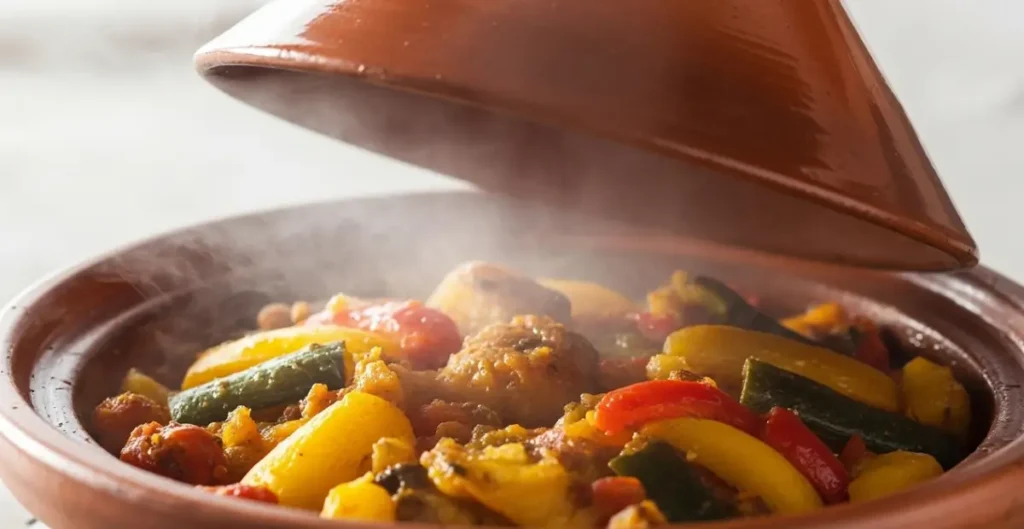
Moroccan Tajine – There is a moment of quiet ceremony when the conical lid is lifted from a Moroccan tajine. A plume of fragrant steam carries the scent of a hundred sun-drenched markets—cumin and ginger, slow-cooked lamb, sweet apricots, and briny olives.
It is a moment of collective anticipation, where strangers become guests, gathered around a single, beautiful vessel. This is the magic of the tajine: less a dish, and more a portable homeland; a clay compass that points not north or south, but directly to the heart of human connection.
Moroccan Tajine
At first glance, the tajine is profoundly local. Its very form is an ancient answer to a specific environment—the heavy, shallow base and tall, conical lid are a masterpiece of desert ingenuity, designed to trap precious moisture and cook food slowly over scarce embers. The clay itself seems to taste of the Moroccan earth. To eat a tagine djej bil hamd markd (chicken with preserved lemon and olives) in the medina of Fez is to taste a place, a history, a family story that spans generations.
Yet, lift that lid and you will find the world inside.
The tajine’s story is written in spices that traveled ancient trade routes. The saffron that tints the broth a golden amber likely journeyed from Iran or Spain. The ginger and turmeric whisper of the Far East, brought by caravan and dhow. The very concept of sweet-and-savory, like lamb with prunes or quince, speaks to the Persian and Andalusian tastes that wove themselves into the fabric of Moroccan cuisine during the great Islamic empires.
But the tajine’s internationality is not frozen in history. It is a living, breathing conversation. It is the adaptability of the pot itself. In a home in Paris’s 18th arrondissement, a second-generation Moroccan mother might make a tagine bil kefta (meatball tagine) for her French neighbors, who bring a baguette to soak up the sauce—a delicious, unspoken fusion. In a Brooklyn apartment, a young cook might follow a YouTube tutorial, substituting sweet potatoes for turnips and adding a chipotle pepper for smokiness, creating a new, transatlantic dialect of the dish.
The tajine’s true language is one of hospitality, not rigidity. It is a forgiving dish. It asks for what you have: root vegetables in winter, fresh zucchini in summer, fish by the coast, and poultry inland. It is democratic; it tenderizes the humblest cuts of meat and elevates simple vegetables into something profound. This inherent flexibility is why it has taken root in global kitchens. It doesn’t demand exotic ingredients; it invites interpretation. The Swedish home cook might add dill to a fish tagine. The Brazilian might include a hint of coconut milk. The pot accepts them all.
To share a tajine is to participate in a universal ritual. There are no individual plates. Hands reach with bread from the same basket to scoop from the same communal well of food. The act breaks down barriers. You are not just eating food; you are eating from the same geographical and cultural crossroads—sharing the cumin from India, the olives from the Mediterranean, the dried fruit from the Atlas Mountains, and the slow-cooked patience that every culture, in its own way, understands as love.
So, the next time you see the iconic cone-shaped lid, remember: it is a roof. A shelter under which the flavors of continents have gathered to simmer. It is a meal that quietly argues that our most local traditions are, in fact, beautiful maps of our shared world. All you need to read them is a piece of bread, and an open seat at the table.
So, the next time you see the iconic cone-shaped lid, remember: it is a roof. A shelter under which the flavors of continents have gathered to simmer. It is a meal that quietly argues that our most local traditions are, in fact, beautiful maps of our shared world. All you need to read them is a piece of bread, and an open seat at the table.
So, the next time you see the iconic cone-shaped lid, remember: it is a roof. A shelter under which the flavors of continents have gathered to simmer. It is a meal that quietly argues that our most local traditions are, in fact, beautiful maps of our shared world. All you need to read them is a piece of bread, and an open seat at the table.
So, the next time you see the iconic cone-shaped lid, remember: it is a roof. A shelter under which the flavors of continents have gathered to simmer. It is a meal that quietly argues that our most local traditions are, in fact, beautiful maps of our shared world. All you need to read them is a piece of bread, and an open seat at the table.